As a CFO, I want to see what's driving a revenue change — not just that it changed — so I can explain the quarter to my board with confidence.
An AI revenue-intelligence platform — Atrium — that helps a wealth-management CFO move from fragmented dashboards to a single, explainable narrative: knowing not just what changed, but why.
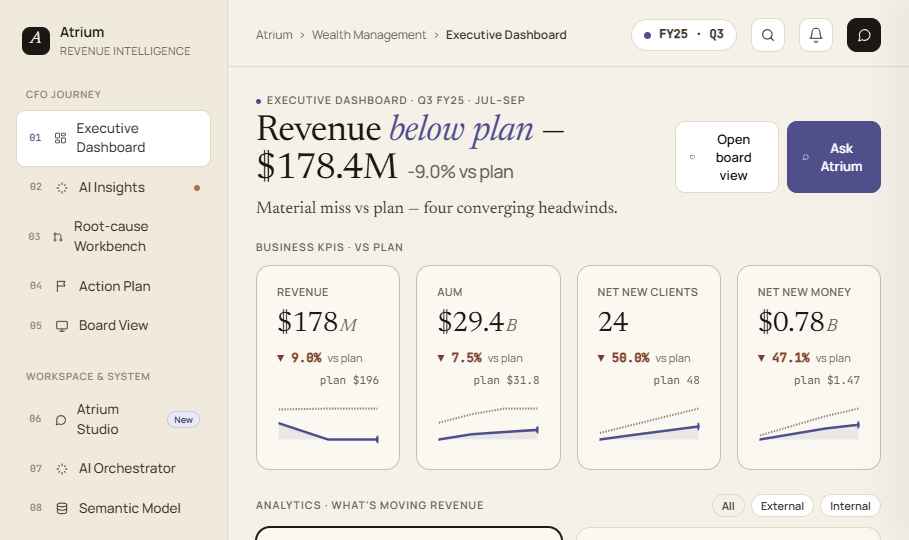
Atrium — the CFO opens to a revenue narrative, not a wall of charts.
Traditional dashboards bury business users in graphs and tables. I designed an insight-first experience that surfaces KPIs, regional views, and root causes as a clear, decision-ready narrative.
A vision for analytics business users actually understand — insight-first, not chart-first — to justify a platform investment.
Atrium: an AI revenue-intelligence platform with a centralized orchestrator, explainable insights, and human-in-the-loop validation.
It turns days of fragmented analysis into minutes of explainable, board-ready narrative the CFO can defend.
They fail to connect cause, context, and consequence fast enough. In wealth management, revenue lives or dies on fees — and when fees dip, no one can say why in time to act.
A CFO sees outcomes, but not drivers. By the time a decline surfaces, the root cause is already buried under fragmented reports.
a material quarterly miss with four converging headwinds — weather, staffing, client withdrawals, and market conditions — none of them obvious in a standard dashboard.
No clear attribution means delayed decisions — the "why" arrives long after the quarter closes.
Data sits in disconnected systems; every insight requires manual assembly across teams and tools.
Too many reports, no narrative. External factors are underestimated and rarely modeled ahead of time.
Before every board meeting, Sally must understand what changed, explain why it changed, and recommend what to do next — across senior advisors, analysts, 25 regions, and AUM performance.
Today that means stitching together multiple teams and systems. I turned her recurring needs into three user stories that shaped the product:
As a CFO, I want to see what's driving a revenue change — not just that it changed — so I can explain the quarter to my board with confidence.
As a CFO, I want to validate and edit the AI's reasoning, so the final narrative is mine — and defensible under scrutiny.
As an analyst, I want self-serve root-cause analysis, so I'm not waiting days on the data team to answer "why."
I partnered with senior designers, in-house SMEs, and data engineers — and built a synthetic CFO persona via prompt engineering to simulate real analytical behavior, mapping objectives → behaviors → measurable signals.
One intelligence layer automates data blending and root-cause analysis across every silo.
CFOs and analysts refine, validate, and adjust every AI insight before it ships.
Insights stay consistent across Power BI, Teams, and presentation tools — wherever the work happens.
Every insight moves from "what" to "why," with a traceable causal chain the board can trust.
I mapped the CFO's path end-to-end, pairing each step with the role the I2I platform plays — and how Sally feels along the way.
↔ scroll to follow the full journey
A working revenue-intelligence console for the CFO. Click through the CFO Journey on the left: Executive Dashboard, AI Insights, Root-cause Workbench, Action Plan, and Board View.
Atrium quantified the revenue decline and attributed it to weather, staffing, and client behavior — turning a descriptive dashboard into a causal explanation the CFO can act on.
Increase the percentage of business decisions driven by actionable, self-serve insights.
I mapped each UX driver to a measurable metric and the business outcome it unlocks — so design value stayed legible to business stakeholders.
For executives, trust comes from explainability — not cleverness.
The breakthrough wasn't a smarter model; it was making the AI's reasoning editable and traceable, so Sally owns the narrative she takes to the board. Human-in-the-loop wasn't a feature — it was the whole point.
Next, I'd pressure-test the causal chains with real finance teams and design the moments where the AI is uncertain or wrong — because that honesty is where executive trust is truly earned.