"It's easier when I can filter events to match my comfort level."
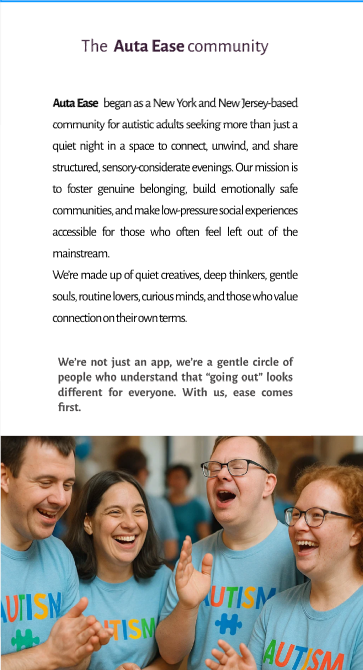
A sensory-smart social platform that helps autistic adults connect, explore, and engage — on their own terms, and at their own pace.

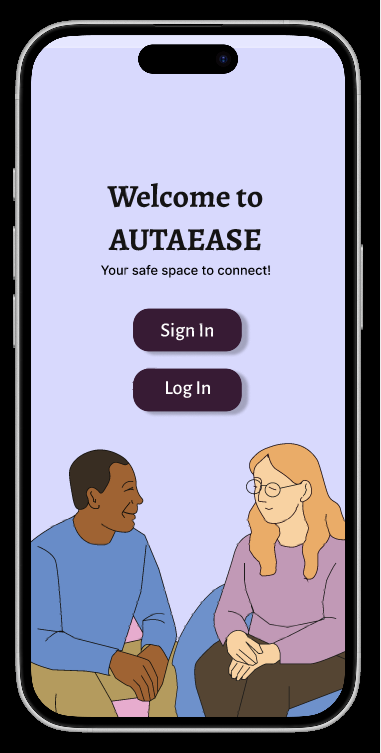
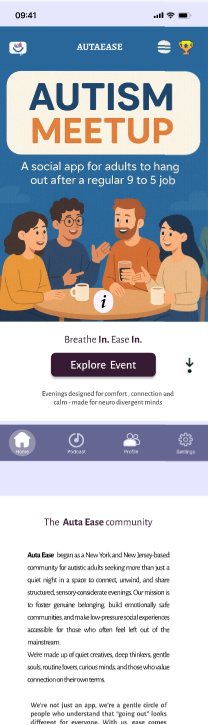
AutaEase — your safe space to connect. Evenings designed for comfort, connection, and calm.
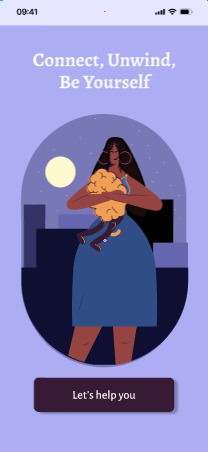
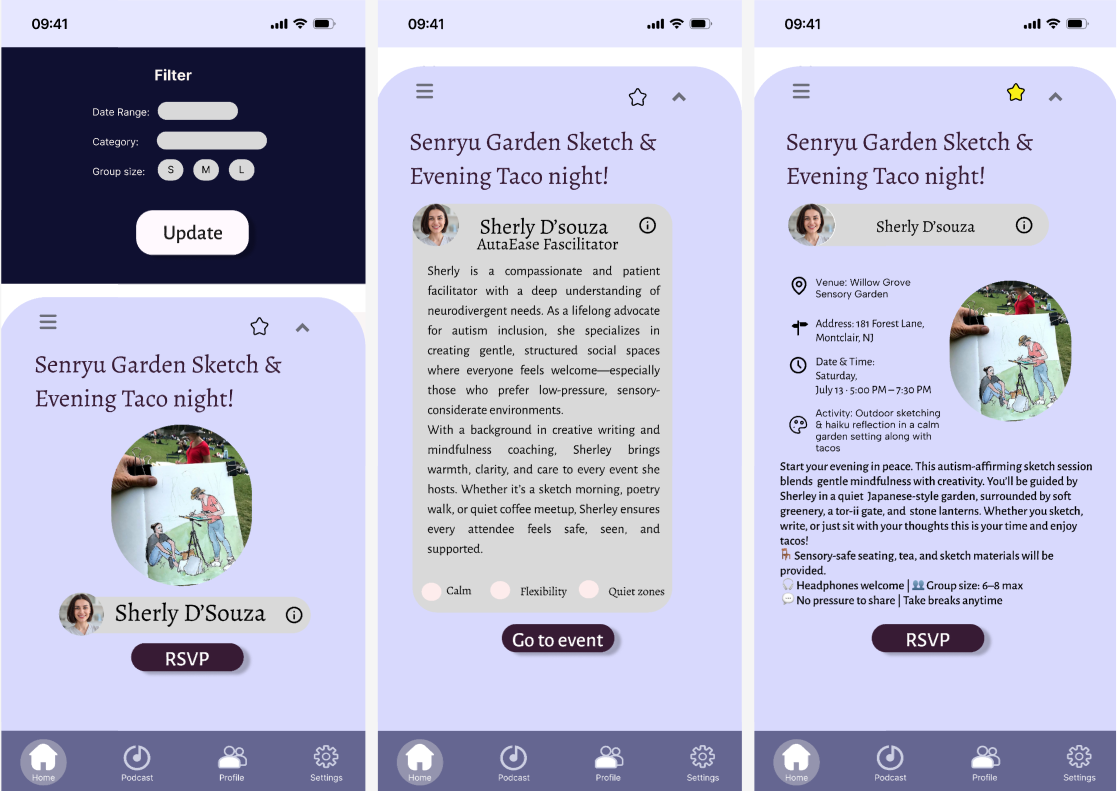
AutaEase helps autistic adults discover, preview, and join sensory-friendly events — filtering by environment, sensory factors, and group size, with rich previews and pressure-free RSVP.
A Rutgers Product Experience & Design project — concept to tested prototype.
A sensory-conscious social platform for autistic adults, rooted in the NY/NJ community.
UX research, information architecture, prototyping, and emotion-based usability testing.
Autistic adults face social isolation during evening hours — when most activities happen in overwhelming, unpredictable environments.
Existing platforms rarely address sensory sensitivities, emotional readiness, or the need for autonomy.
"I want to know exactly what the event will be like before I commit."
Noise, lighting, and crowd size drain energy fast — and there's no way to gauge it in advance.
Without sensory information, there's no way to prepare or feel safe saying yes.
Pressure to participate — or to stay longer than feels okay — keeps people home.

Arun wants to expand his social circle in environments where he feels safe and in control. He researches events, checks photos, and often abandons plans when details are unclear.
"It's easier when I can filter events to match my comfort level."
"Will this be too overwhelming? What if I need to leave early?"
Reads reviews and checks photos; chooses small, familiar groups.
Anxious about the unknown; confident when in control.
In-person interviews and empathy mapping with autistic adults (working, with family support) surfaced a deep need for predictability, sensory comfort, and choice.
Design for trust, comfort, and autonomy — grounded in Norman's Emotional Design.
Nir Eyal's Hooked model: simple triggers, easy actions, and rewarding feedback.
Filters for noise, lighting, and group size — plus a "leave anytime" culture.
Rich previews, sensory maps, and structured calendar RSVP remove the unknown.
↔ scroll to follow the full journey
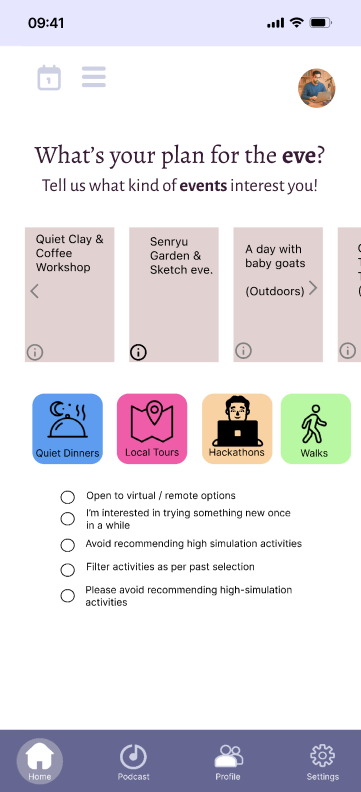
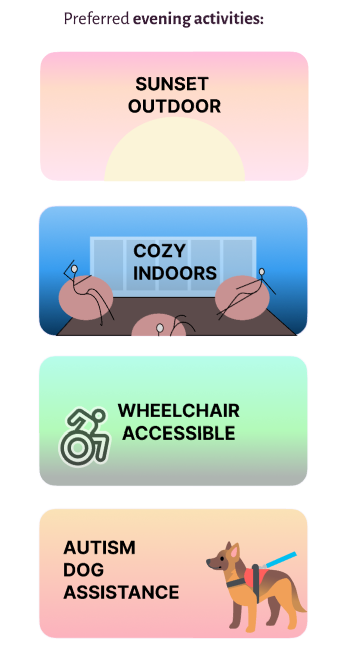
A gentle welcome and daily mood check-in, preference-based event matching, illustrated activity discovery, and a warm community — all wrapped in soft, muted pastels that minimize cognitive load.


Filter by sensory factors, meet the facilitator, then see every detail — sensory-safe seating, group size, take-a-break-anytime — before you commit.
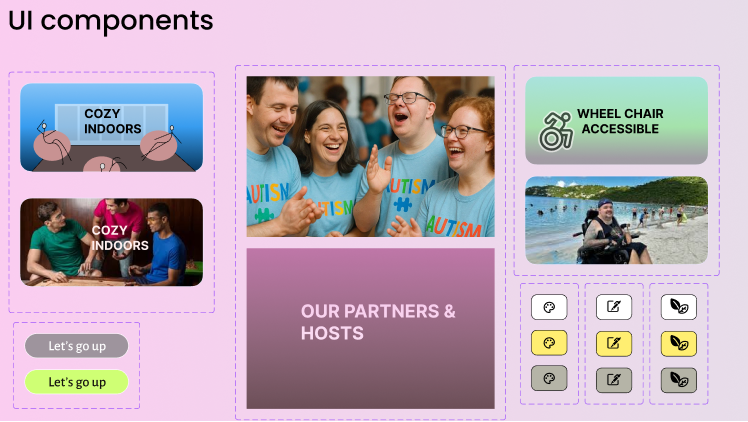
Every colour and type choice works to lower sensory load — soft lavenders for calm, gentle accents for warmth, and a rounded, highly legible typeface.

The goal: confirm the interface is easy to navigate, emotionally safe, and personalized for autistic adults aged 30–50 — so it genuinely supports low-stress social engagement.
A mix of part-time workers, full-time workers, and unemployed adults with family support.
Moderated sessions over Zoom, plus in-person guided testing.
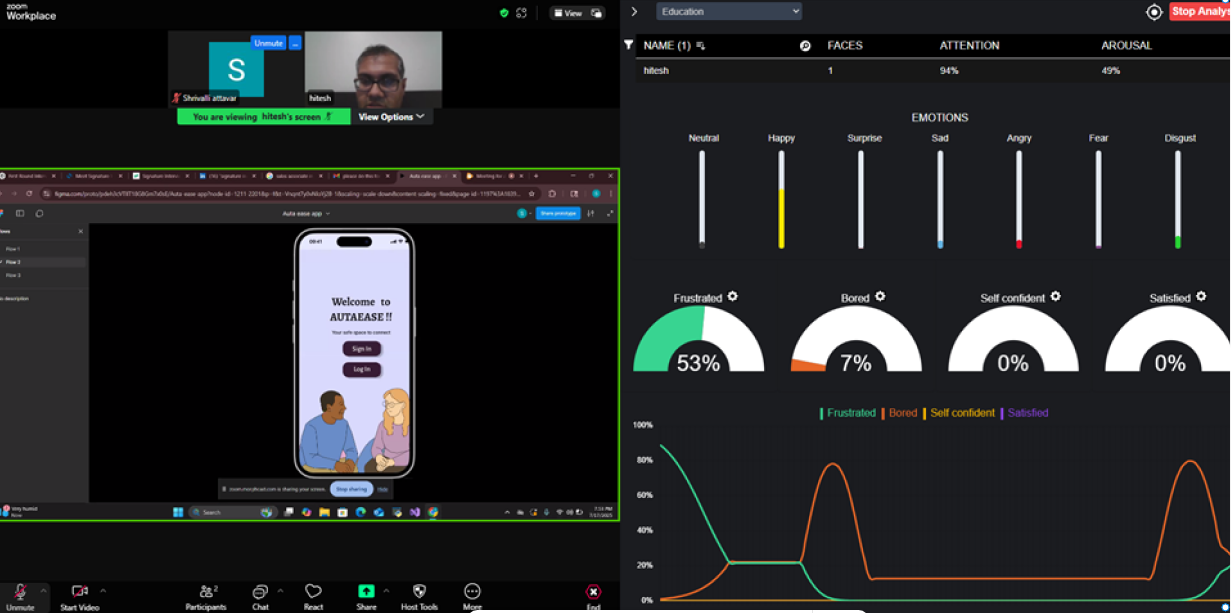
Wireframes tested in Maze; the final prototype run through MorphCast facial-emotion AI to read how users felt.

Reading real emotion mid-session — MorphCast tracked attention, happiness, frustration and satisfaction as users moved through the prototype, surfacing exactly where stress spiked.
We stopped designing for tasks and started designing for trust, comfort, and autonomy — pairing emotional safety with gentle habit formation.
Emotional safety is core — and the next frontier: building quality, trust-based connections between users.
Success depends on committed, sensory-aware event hosts — a dedicated outreach strategy.
Monetization must protect affordability, which users named as a top priority.
Don't get attached to a design — get attached to the user.
AutaEase taught me to blend research, emotional insight, and quick iterative sprints into a process that keeps the user at the center. Concepts changed constantly — and that flexibility is what let the product actually serve the people it's for.
Next: expand community events, run long-term habit testing, and explore AI-based sensory recommendations.